Tuesday, June 20, 2006

Mutant Message Down Under by Marlo Morgan


Oh my gosh this book was really good. Its another one that makes you wonder if the story being told is true. I don't know why but for some reason my book club loves books like that. Anyway this book is about an older woman, early fifties, who is invited on a walkabout (walking barefoot across 1400 miles of rugged terrain) with the last true Aborigine tribe in Australia. Its kind of a shock to her that she goes and she endures many hardships, most of which is amazing. She learns so much about these people and what they think of the outside world and "the mutants" as they call her and us. The longer she is with them (a total of four months) she understands the beauty of how people can be without judgment or greed.

This book gives great insights into society roles and how to value people. In this tribe everyone has a talent and it is used at the right time and celebrated. In this group they do not celebrate birthdays because getting older is not an accomplishment. They celebrate getting better and the person who has grown better announces when he or she wants to have celebration. Also, the importance of understanding our own bodies. That emotion and physical wellness go hand in hand.

I reccommend this book to everyone. It is a quick read. I read it in a day. Now for my favorite part the quotes section:

She explains to the tribe several things about our culture such as gravy and they always find symbolism in it.
"Instead of living the truth, Mutants allow circumstances and conditions to bury universal law under a mixture of convenience, materilism and insecurity."

Symbolism of Frosting
"It seemed to symbolize how much time, in the one-hundred-year Mutant life span, is spent in artificial, superficial, temporary, decorative, sweetened pursuits. So very few actual moments of one's life are spent discovering who we are, and our eternal beingness."

"Why can't Mutants see, if my song makes one person happy, it is a good job? You help one person, good job. Can only help one at a time anyway."

"People are nonliving when angry, depressed, feeling sorry for themselves, or filled with fear. Breathing doesn't determine being alive. I just tells others which body is ready for burial or not!"

There are tons more that I loved. There is pretty much something good on every page. So everyone read it.


Thursday, June 15, 2006

The Red Badge of Courage by Stephen Crane


A classic novel about a young boy fighting in the American Civil War. He finds himself pondering whether he will be able to handle his first battle. Will he run or will he hold his ground? Well, he ultimately runs and in this despises himself and feels shame in front of his other comrades who have no idea what he has done. He tries to justify it but in the end his anger towards himself and his superiors for treating him and the other soldiers like expendable animals drives him to become a quite a warrior.

I don't think I gave this book the attention it deserved. I was just kind of reading it to read it. So as I was reading my mind wandered sometimes and usually when that happens I backtrack and reread what I missed but I didn't do that here because I really didn't care. The only times I did backtrack was when I was so lost about what was going on and I had no idea what the characters were talking about.

Not to say that this wasn't a good book but it was just kind of a filler for me until my book club picked the next book. The imagery and use of color was very interesting especially the color red was symbolic all throughout the book. The last chapter really hit me. I love it when books have good endings. So I'm kind of on the fence about this one. Its a quick read.

Monday, June 05, 2006

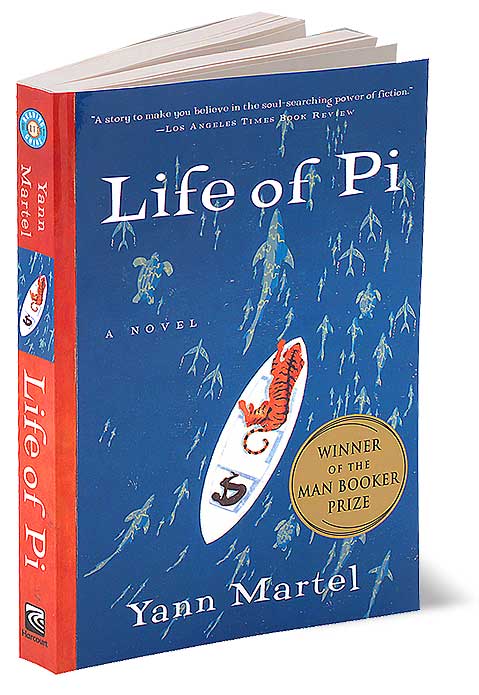
Life of Pi by Yann Martell


This was the second book chosen for my book club. It was an extremely good book and one I don't think I would have ever read if not for the book club. The story touches on so many aspects: science, religion, zoology, survival techniques. Its quite a story interlaced with good philosophies. For those who don't know this book is about a sixteen year old boy who is the only one to survive a shipwreck on a lifeboat with several zoo animals one of which being a tiger. It tells the story of how he is able to co-exist with this tiger and face all the dangers of the sea. It was really exciting to read.

Now there was a debate at my book club whether or not this was a true story. I don't think it is even though there is an author's note and everything (that was my roommate's point). I have read and heard of several books who use this trick to make their books more interesting. And I have found an article written by the author talking about how he came up with the story. If you have read the book, you should read this article. It was very interesting.

Yann Martel is an excellent writer. Though this book can be graphic and intense at times he also mingles in some comedy that relieves the stress you feel. Also, I love his defense of zoos. How they have become so unpopular nowadays with animal rights activists and he compares it to religion in that being against either is to have an illusion of freedom. Having the main character practice three religions at the same time was quite funny and inspirational.

Not to ruin anything but if anyone who has read this book sees you reading this book they will almost always say "The end is so good. There's a real twist." Now when I got to the end I didn't have a "oh my gosh" moment. I just thought it was interesting. Maybe because I had high expectations or something. The end is very interesting and the reader is asked to make an internal choice. My book club was split on the choice. I believed the second choice. Maybe because I am more negative towards the human race. Still this book makes you think. Now on to some of my favorite quotes:

As he realizes that the tiger is still on board and fully takes it in here is Pi's thought (one of the funny quotes):
"You might think I lost all hope at that point. I did. And as a result I perked up and felt much better."

"Some of us give up on life with only a resigned sigh. Others fight a little, then lose hope. Still others--and I am one of those--never give up. We fight and fight and fight. We fight no matter the cost of battle, the losses we take, the improbability of success. We fight to the very end. It's not a question of courage. It's something more constitutional, and inability to let go. It may be nothing more than life-hungry stupidity."

"It is simple and brutal: a person can get used to anything, even to killing."